
When you arrive at Great Sand Dunes National Park and Preserve in southern Colorado, one landmark is impossible to miss: High Dune. And you don’t just look at it. You can hike it.
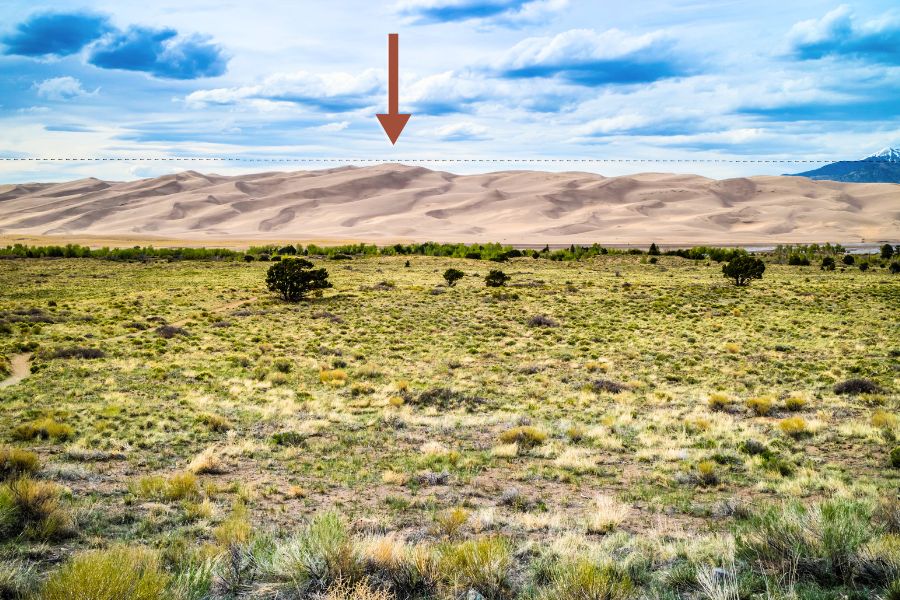
Set within the tallest dunes in North America, this is the climb many visitors aim for first. From a distance, it looks straightforward. It’s right there, front and center, feeling very much like a quick detour.
And then you start walking…
Jump to what you need:
Overview:
- High Dune hike overview
- Our hiking experience
- What this hike is actually like
- Tips for hiking High Dune
Practical planning:
This website uses referral links. Please read our disclosure policy for more information.
High Dune hike: quick overview
High Dune sits along the first major ridge of the dunefield, making it the most accessible “big climb” in the park, and one of the most popular things to do in Great Sand Dunes National Park. It’s tall enough to feel like a real challenge, but still doable without committing your entire day.
Because it rises from the first ridge, it’s visible from the main access area and easy to aim for, which is why most visitors choose it over deeper named dunes like Star Dune or Hidden Dune.
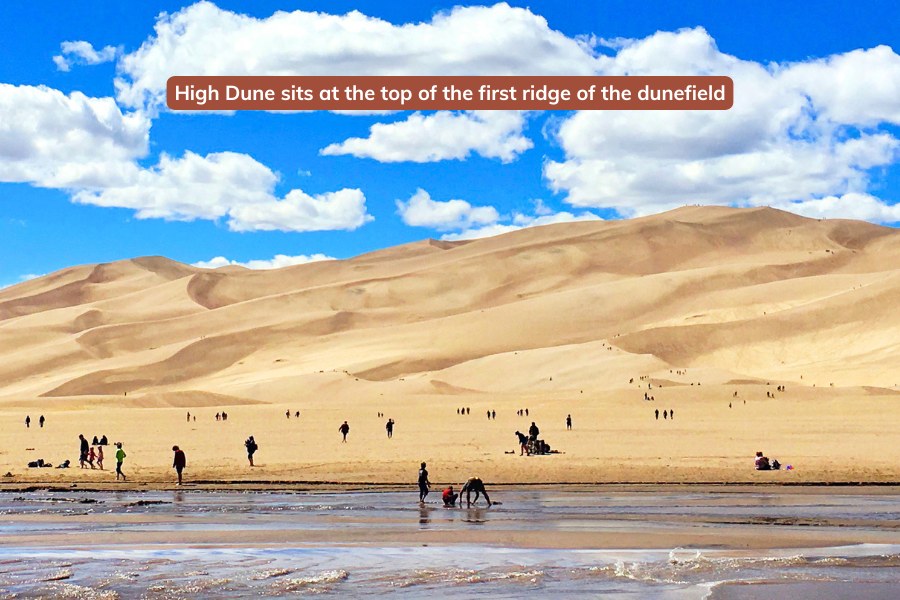
It also plays a bit of a visual trick. While Star Dune and Hidden Dune are taller on paper, around 740 feet from base to summit, High Dune has the high-ground advantage. At roughly 690 feet tall, it still reaches a higher summit elevation (about 8,700 feet), which is why it looks like the biggest climb.
Quick facts:
Type: Open dune hike (no set trail)
Distance: Variable (~2.5 miles round trip from the Dunes Parking Area)
Difficulty: Strenuous (deceptively hard)
Elevation Gain: ~500-700 ft (varies)
Time: 2–4 hours round trip
Starting point: Dunes Parking Area / Visitor Center / Campground
Dog-friendly: Yes (with important caveats)
Fee: Yes (U.S. National Park Service entrance fee)
👉 This isn’t your typical hike, and it doesn’t behave like one.
Before you head out, here’s a quick look at how High Dune fits into the broader park layout, including key access points, nearby activities, and helpful stops:
Our experience hiking High Dune
We started from the campground a little before 10 a.m. (Which, in hindsight… was already a mistake.)
The plan was simple: quick up, quick down, back in time for lunch.
We didn’t set out to hike High Dune specifically. The goal was just to explore the dunes with the kids and see how far we’d get.
As we approached the wide dunefield base and scouted the horizon, we couldn’t miss one towering peak dominating all the others: High Dune.
“Looks doable,” I said.
Famous last words.
The part where you realize this is not a normal hike
The first obstacle: Medano Creek. A wide stretch of snowmelt, flowing very generously that morning.
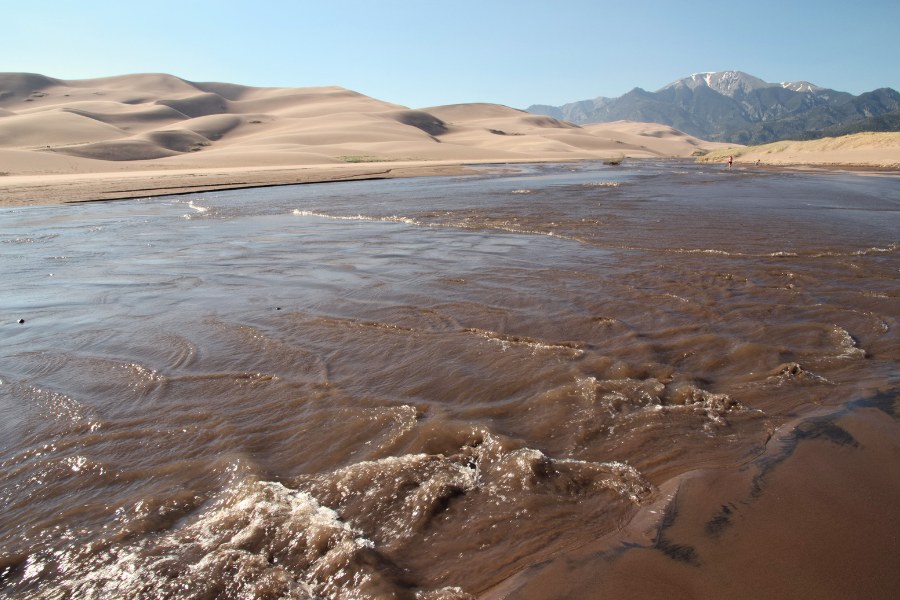
No bridges. No way around it. Just straight through. We did the usual routine — shoes off, pants rolled up.
The water was freezing. Like, instant regret freezing.

I kept telling myself that this would all be worth it in the end and that it was “all in my head,” but the pep talk failed because liquid ice is my kryptonite (which is exactly why I volunteered my husband for the nearby Zapata Falls Trail).
My feet tingled at first, then they straight-up hurt, then they went totally numb.
Meanwhile, as I was waddling through the stream, contemplating whether permanent nerve damage was a fair market trade for a view of some sand, my firstborn sprinted back and forth across the Arctic runoff like it was a freaking splash pad, yelling “I want to do it agaaainnnn!!!,” systematically soaking the last remains of my will to live.
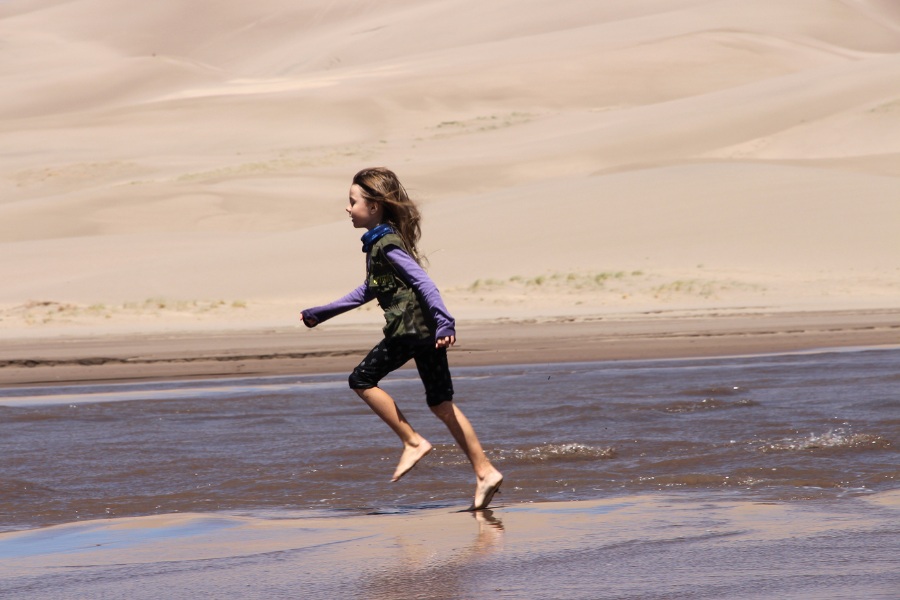
About halfway through the snowmelt shuffle I scooped up my younger one — stranded and shivering but laughing hysterically. It was noticeably easier to get across in “Mama Bear” mode, but the numbness was real.
Strong start.
The climb
Once across, everything opens up.
No trail. No signs. Just piles of sand.
You pick a direction and start walking. And almost immediately, you slow down.
The sand is soft, unstable, and completely unforgiving. Every step sinks. Every step slides back.
As we neared the first ridge, my feet sank so deep into the sand that I toppled over. I scrambled back up and made three longer strides, only to slide right back, now entombed in sand nearly to my knees.
I tried big steps, small steps, side steps, and crawling. None of it helped.
Meanwhile, the kids somehow defied the laws of gravity and cruised past me like it was recess.
Eventually, after enough flailing and one very humbling rescue assist from my husband, I found some rhythm.
We continued along the ridgeline, where the sand was firmer and slightly more forgiving.
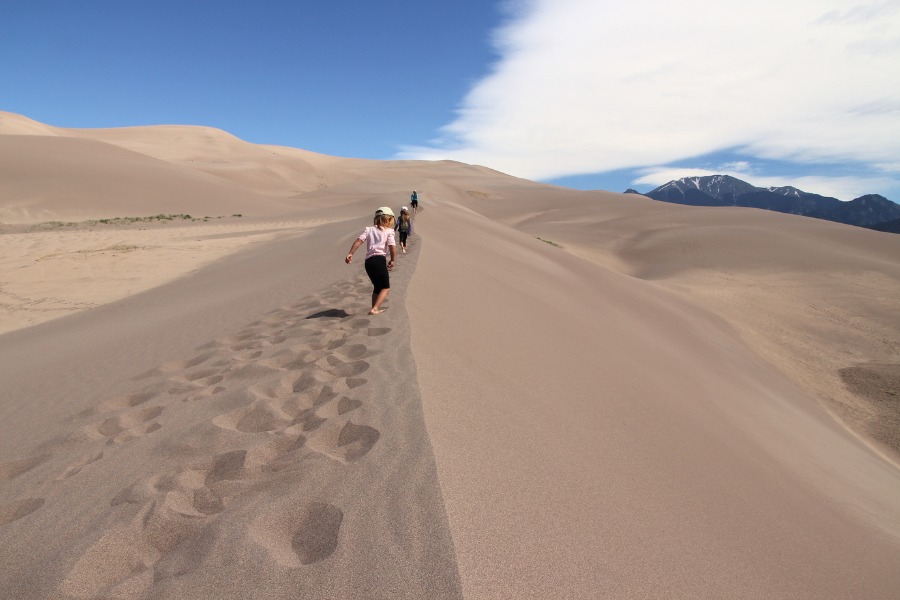
Still brutal. Just… slightly less brutal.
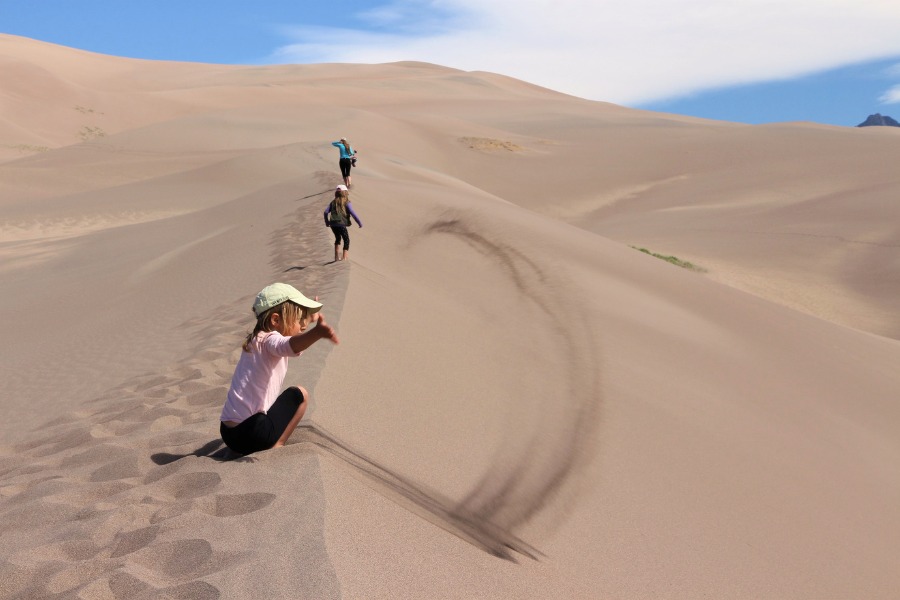
The sand has moods (and they change fast)
At first, the sand felt cool.
Then warm.
Then suddenly we were playing a very real version of “the floor is lava.”
There was no transition. One step was perfectly fine, and the next had us doing high knees like our lives depended on it. Except every time our feet touched the sand, the surface temperature jumped another 20 degrees.
At high elevation, sand doesn’t mess around. It turns into a Hell’s Kitchen deep fryer.
We scrambled to get our shoes back on, kids first, all while hopping around like absolute lunatics. For a few minutes, it was pure madness. Our shrieks might still be echoing through the dunes to this very day.
The biggest mental trick on the dunes
This is where the dunes really get you.
Every time you think you’re close to the top… you’re not.
What looks like the final ridge reveals another one behind it. And another. And another.
It’s the ultimate false summit situation.
You climb what feels like the last push…

…only to discover it was all a lie.
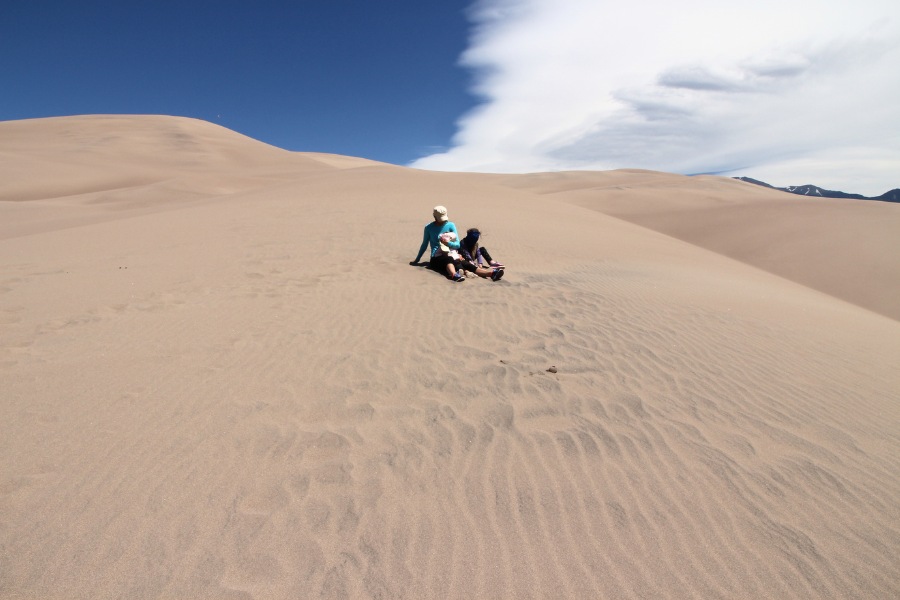
Wind: the final boss
Then came the wind.
At first, it was manageable. Then it wasn’t.
Sand started hitting our legs. Then our faces. Then everywhere.
The gusts picked up, swirling in every direction, sometimes strong enough to stop us in place. At times it was hard to even look forward.
I had to test the waters though… “You guys, it looks like we’re only one peak away now…?”
[Crickets…]
The kids were done. Hot, tired, wind-whipped, and over it.
Honestly? Same.

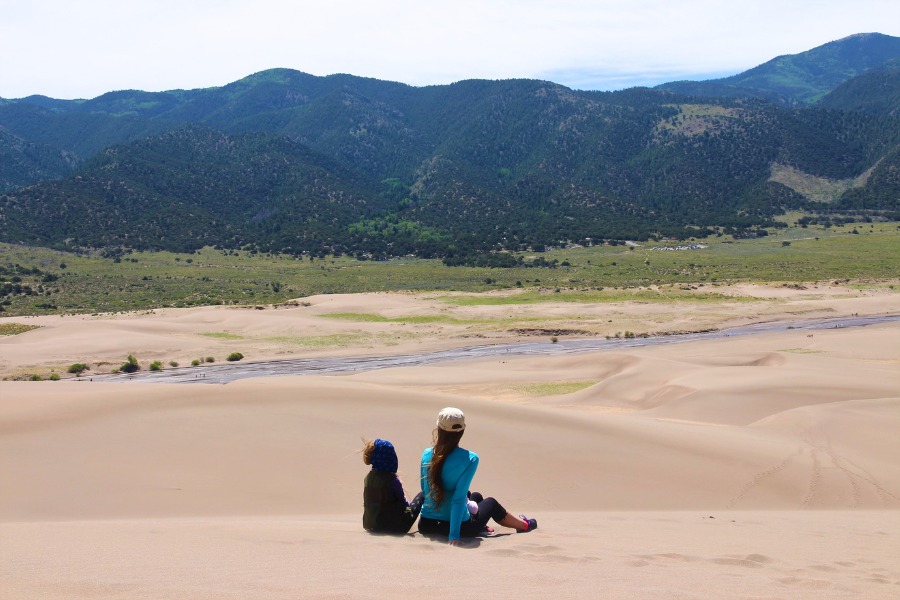
But during the approximately two-second breaks from the blowing sand, the views were absolutely stunning.
I couldn’t get enough of the way the rugged mountain range and the lush valley below contrasted with the vast, golden dunefield. Seeing Medano Creek snaking along the dunebase was the cherry on top.
Turning around (and why it was the right call)
At some point, our crawl came to a dead stop.
Not at the summit. I’m not even sure how close we truly were.
But between the heat, the wind, and the fact that we were also beginning to run low on water, it was the right call.
And honestly? It still felt like a win.
Because this hike isn’t really about reaching the top.
It’s about the experience.
The scale.
The effort.
The deafening silence between the gusts of wind.
And that moment where you look around and think… this place makes absolutely no sense.
The way down (arguably worse… or better?)
Going down sounds easy.
It’s not. In its own way, it’s just as challenging as the climb.
The sand swallows your feet, cooks your ankles, and basically forces you to run whether you want to or not.
Gravity takes over, and suddenly you’re committed to a pace your legs aren’t sure they can handle.
We ran most of the way down, straight back toward Medano Creek.
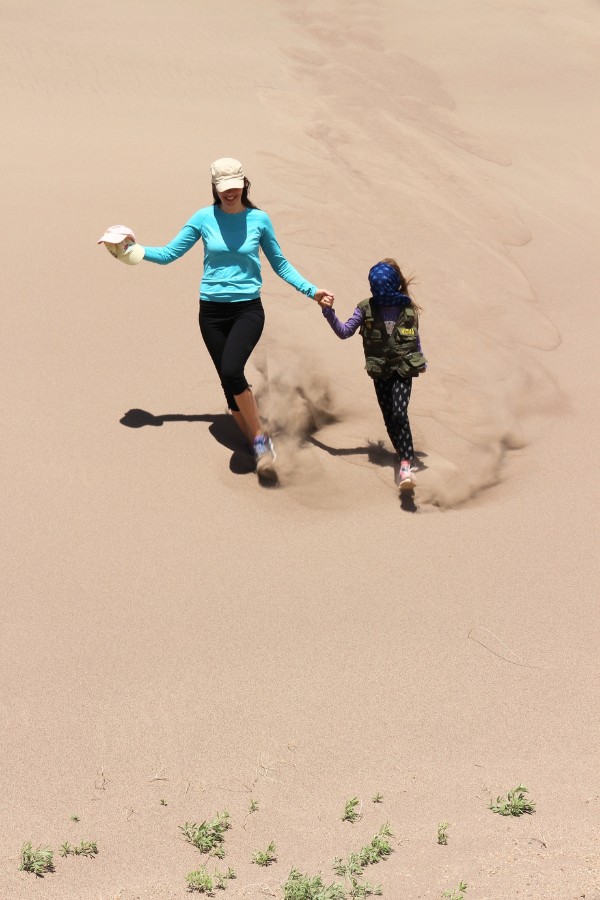
The second we reached it, the kids jumped in like the desert torture never happened.
Reset complete.


What this hike is actually like
This isn’t a typical hike.
There’s:
- no trail
- no distance markers
- no stable footing
- no shade
And everything works against you:
- sand slows every step
- heat builds fast
- wind can be relentless
👉 Expect it to take longer than you think and to feel harder than it looks.
Tips for hiking High Dune
Getting to the dunes
Most visitors start from the Dunes Parking Area near the Visitor Center and walk straight onto the sand. If you’re staying at the campground, you can walk directly from your site, but it adds distance.
Start early or go late
This is the difference between enjoyable and miserable. Midday heat on the dunes can be intense.
Bring more water than you think you’ll need
You’ll use it.
Wear closed-toe shoes
Yes, they’ll fill with sand. Still better than burning your feet.
Barefoot is possible — but temporary
There are no harmful critters in the dunes that would go after your toes, but heat becomes the limiting factor quickly.
Watch sand temperature
It can exceed 150°F in summer. Not exaggerating.
Prepare for wind
It’s significantly stronger on the dunes than at the base. Protect your eyes with a bandana or a pair of sunglasses you’re prepared to sacrifice to the sand gods. As for your gear, wrap it in ziplocks or bury it deep in your pack. The sand doesn’t just get “everywhere,” it becomes a permanent part of your DNA.
Prepare for sun
There is zero shade. Plan accordingly.
Keep an eye on the weather
Afternoon storms can build quickly, especially in summer. If you see storm clouds moving in, it’s best to leave the dunes ASAP.

Want to go farther?
If you’re considering a longer or more ambitious climb, including Star Dune or remote parts of the dunefield, be sure to check the official National Park Service page for current conditions, route guidance, and safety updates.
Hiking High Dune with a dog
Leashed dogs are allowed on the dunefield up to High Dune, BUT this is one of those situations where “allowed” doesn’t necessarily mean “a great idea.” Between hot sand, unstable footing, full sun exposure, and wind, this can be a tough outing for most dogs.
For a full breakdown of dog-friendly areas in the park, safety tips, and what to realistically expect, check out our complete guide to visiting Great Sand Dunes National Park with dogs.
👉 If you bring your dog onto the dunes, early morning or evening is essential, and dog booties might be necessary (we like these because they’re budget-friendly and stay on well).
Is the High Dune hike worth it?
Yes.
Even if you don’t make it to the top.
Especially if you don’t.
Because what sticks isn’t the summit. It’s everything it took to try.


Hi, I’m Marketa!
Mom of two, Malinois wrangler, and the voice behind this blog. I share places worth the detour across the U.S., from remote backroads to favorite Chicago-area finds. Always chasing good views, great memories, and dog-friendly stops. More about us →


