
When we visited the Josie Morris Cabin on the Utah side of Dinosaur National Monument, we got a glimpse into the life of Josie Bassett Morris, who lived here from 1914 to 1964. The park does share a little of her story, but honestly? It barely scratches the surface.
The real Josie was far more fascinating than the brochures let on. She wasn’t just another pioneer woman. She was a sharp-witted, fearless figure of the Old West who carved out a life on her own terms. Her story deserves a bigger spotlight, and I couldn’t resist digging deeper.
So here’s what I found — let’s keep Josie’s spirit alive!
- The early life of Josie Bassett Morris
- Life in Brown’s Park, Colorado
- The Bassett family’s ties to outlaws
- Josie’s marriages, divorces, and rumors of murder
- Building a new life in Cub Creek (homestead years)
- Defying female stereotypes of the Old West
- Bootlegging, poaching, and a trial with a twist
- Josie Bassett Morris and Butch Cassidy
- Josie’s final years
- Josie’s legacy
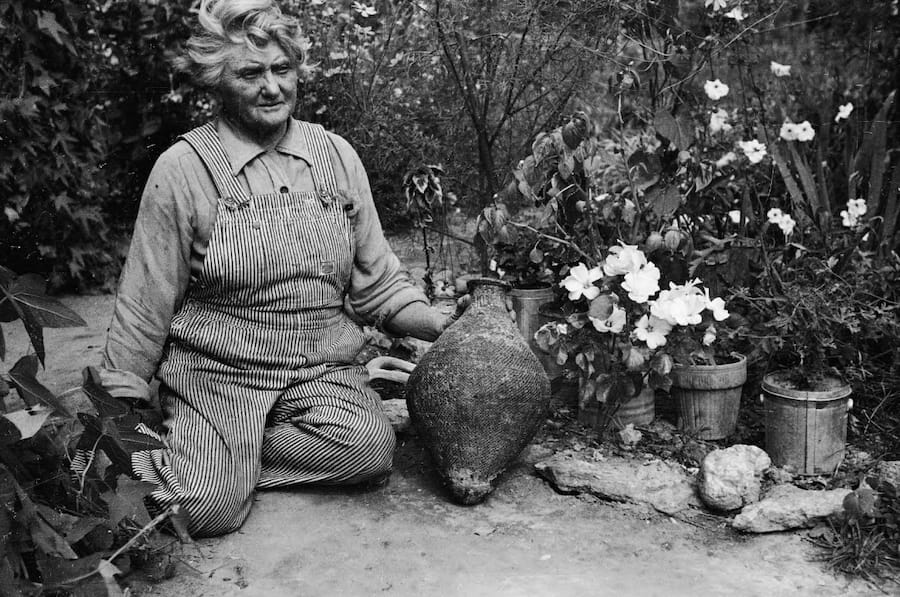
The early life of Josie Bassett Morris
Josephine “Josie” Bassett was born on January 17, 1874, in Rockport, Arkansas, to Amos Herbert (Herb) Bassett and Mary Elizabeth Chamberlain Bassett (Elizabeth). She was their first child.
(Quick sidebar: Elizabeth was only 16 when she married 37-year-old Herb. Some say she was looking for the father figure she never had after losing her parents young and being raised by her grandfather, together with her sister; others think she was drawn to his opposite personality. Either way, their marriage seemed to have worked — in its own unconventional way.)
By the time Josie was three or four (around 1877), the Bassetts set out to relocate to California. On the way, they stopped to visit Herb’s half-brother in Brown’s Park, Colorado (then called Brown’s Hole) on the Utah–Colorado border. That visit changed everything. Elizabeth fell in love with the valley — wide, grassy, split by a river and ringed with rugged hills, and the family decided to stay. At the time, they had two kids (Josie and her younger brother Samuel), and another on the way.
Brown’s Park became home where they eventually raised five children: Josie, her brothers Samuel, Elbert, and George, and her sister Anna (Anne). The family established a ranch here, which became both their livelihood and the backdrop of Josie’s formative years.

Life in Brown’s Park, Colorado
Life in Brown’s Park was anything but ordinary.
Josie’s mother, Elizabeth, ran the family ranch with grit and flair. She might have looked petite in her tailored dresses, but don’t let that fool you. She was as tough as they came, teaching her kids to rope cattle, ride horses, and shoot, all from a very early age. By age eight, Josie could ride and rope with the best of them. Elizabeth also had her own no-nonsense code of survival. Stray cattle? Rebranded as hers or promptly butchered. Technically, the cows were trespassing, and this was the Old West, after all.
Herb Bassett, on the other hand, was mild-mannered and more into Shakespeare and music than roping cattle. Still, he built the family cabin, piped water from a nearby spring, and later became postmaster. He even organized a small local school. He pitched in wherever needed around the ranch, but there was no question: Elizabeth was the one running the show.
Between Elizabeth’s fortitude and Herb’s intellect, the Bassett children grew up both well-educated and tough as nails — an unusual combo for the frontier. While little is recorded about the Bassett boys, both Josie and her sister Ann attended prominent boarding schools, learning literature and refinement. By their teens, they were back at the ranch, mastering the skills of ranch life alongside their mother.
It’s no wonder the Bassett girls developed reputations as sharp-witted, strong, and fiercely independent. Everything written about them hints that they were also strikingly attractive.
The Bassett family and their outlaw connections
The Bassett ranch wasn’t just a home — it became the social hub of Brown’s Park. Everyone was welcome here, no questions asked. Nobody ever left hungry. Elizabeth Bassett was an articulate conversationalist and an excellent hostess who never tired of anyone entering their home: peddlers, cowboys, prospectors, and yes, the outlaws who often slipped through the valley.
Names like Butch Cassidy, Elzy Lay, Kid Curry, and “Black Jack” Ketchum weren’t strangers here. Outlaws stopped by for food, supplies, horses, or even to borrow a book from Herb’s impressive library. In return, many lent a hand on the ranch.
The Bassetts developed their own code of ethics — live and let live, so long as everyone behaved in Brown’s Park. That mutual respect turned out to be handy when wealthy cattle barons tried to strong-arm the Bassetts off their land. Having outlaw friends on your side was a powerful insurance policy.
But hardship struck in December 1892, when Elizabeth Bassett died suddenly at just 37, likely from appendicitis. Her loss was a devastating blow to both her family and the ranch she had built, given the extent of work she was capable to singlehandedly manage herself.
Josie’s marriages, divorces, and rumors of murder
The year after her mother’s death, Josie — then about 19 — married James Fielding “Jim” McKnight. Together they had two sons: Crawford George (1893) and Amos Herbert, nicknamed “Chick” (1895).
But the marriage didn’t last.
And neither did the next one.
Or the one after that.
In fact, Josie married five times in total, divorcing four husbands — a scandalous tally in an era when even one divorce branded a woman for life.
One husband, Emmerson Wells, died under murky circumstances that fueled decades of rumors. The official cause? Strychnine poisoning. The whispers? Josie slipped it into his coffee. While we’ll never know the truth, what’s clear is that Wells was an abusive, hard-drinking man. Whether foul play or his own hand, his death remains a mystery and part of Josie’s legend.
Building a new life in Cub Creek (Josie’s homestead years)
Records show Josie moved around after her early marriages, possibly returning to the family ranch at times. But in 1914, nearly 40 years old and short on money, she set her sights on Cub Creek, a lush valley about 40 miles from Brown’s Park; today part of Dinosaur National Monument. She filed a homestead claim and built a modest cabin with a little help from her son, Crawford. Crawford and his wife tried the rugged life for a while, but she quickly decided this wasn’t for her. Josie stayed.
Related: 7 Unforgettable Things to Do in Dinosaur National Monument, Utah
Ten years later, in 1924, Josie built herself a sturdier home — the cabin visitors see today at the end of Cub Creek Road in Dinosaur National Monument — Josie Morris Cabin. Sorting through sometimes-contradictory records, it seems around this time Josie met and briefly married her last husband, Ben Morris. The marriage fizzled fast, and local lore claims she chased him off with a frying pan before divorcing him like the others.


Defying female stereotypes of the Old West
Josie lived the pioneer life on her own terms. Outspoken and independent, she ignored the expectations of women in her time. Take her love life for example: she married five times and divorced four husbands. In an era when one divorce could ruin a woman’s reputation, Josie wasn’t losing sleep over what people thought.
Her independence went far beyond her marriages. After moving to Cub Creek, Josie ditched long skirts and grew practical, wearing pants and keeping her hair short. She wasn’t trying to make a statement — she was just tired of getting snagged on bushes. Supposedly, she once hacked herself free with an axe after her skirt and hair got hopelessly tangled in the brush. After that, out came the scissors. No more nonsense.
Bootlegging, poaching, and a trial with a twist
Josie also knew how to make ends meet when times were lean. During Prohibition, she reportedly brewed and sold bootleg whiskey. During the Great Depression, she fed the hungry and gave shelter to the desperate, even if it meant sleeping in a dugout herself. To support her household, she wasn’t above a little deer poaching or cattle rustling. Not out of greed, but out of necessity.

Those who knew her remembered Josie as sharp-witted and endlessly generous.
And when the law came for her, she played the system with a smile. At 62, she was arrested for butchering stolen cattle. But when trial time came, she showed up dressed to the nines — her hair neatly pinned, clothes elegant and proper. Who could believe this petite soft-spoken “grandma” was rustling cattle in her spare time? The jury didn’t. After two trials, she walked free. Evidence? Ignored. Reputation? Intact.
Well played, Josie. Well played.

The Josie Bassett Morris and Butch Cassidy connection
Not only did she grow up around the outlaws, but Josie may have even had an affair with Butch Cassidy himself, though the details (and timing) are fuzzy depending on who’s telling the story. Either way, that’s her business, not ours, right? What matters is that she knew the outlaws, and she knew them well.
Romance aside, Josie and her sister Ann were on excellent terms with Cassidy’s gang, the Wild Bunch. In fact, they were two of the only women ever welcomed into Robbers Roost, one of the outlaws’ most notorious hideouts. Just picture it — two teenage girls trading jokes and secrets with the most wanted men in the West, carrying stories they never told anyone.
Years later, rumors suggest that Josie may have seen Cassidy again. By several accounts — including Josie’s own words — Butch Cassidy himself visited her in the 1920s or 30s, decades after he was supposed to have been killed in Bolivia. Whether or not he ever came to her Cub Creek cabin is unknown, but the timing lines up with when she lived here. For what it’s worth, various claims (outside of Josie’s) also suggest Cassidy survived, slipped back into the U.S., and lived quietly until passing away in Nevada in the mid-1940s.
Josie’s final years
Josie Bassett Morris passed away on May 28, 1964, at age 90, after being hospitalized for complications from a broken hip she suffered on her homestead. Some sources list her date of death as May 1, but her death certificate gives May 28.
Josie’s legacy: Trouble, kindness, and independence
By societal standards, Josie Morris spelled trouble. She ran a homestead entirely on her own, wore pants and short hair, butchered stolen cows and poached deer, divorced a few husbands (and may or may not have poisoned one), made illegal booze, and maintained a close bond with Butch Cassidy’s gang. Basically, she rewrote the rulebook for women of her time.
But don’t get it twisted — Josie was also kind, generous, and fiercely loyal.
Dang, Josie, you were a badass little lady with a muscle, wit, and iron will. I would have loved to knock on your door for some coffee and a hearty chat! I bet you baked a mean pie, too.
I have nothing but respect for you.
In memory of Josie Bassett Morris
May her spirit shine as bright as the Utah sun.
— 1874–1964
📷 Photo credit: The following images in this article are used with permission from the Uintah County Library Regional History Center:
https://collections.lib.utah.edu/ark:/87278/s6qk0x76
https://collections.lib.utah.edu/ark:/87278/s6sv14sm
https://collections.lib.utah.edu/ark:/87278/s6tt85zw
https://collections.lib.utah.edu/details?id=405584&page=2&q


Hi, I’m Marketa!
Mom of two, Malinois wrangler, and the voice behind this blog. I share places worth the detour across the U.S., from remote backroads to favorite Chicago-area finds. Always chasing good views, great memories, and dog-friendly stops. More about us →



Great info on this old gal! I think I know more than one fiesty lady that could have been a friend of hers. As a female cattle rancher today, I admire the spunk it took to buck the odds back then. My mom is one of the first women to rise to leadership in national cattlemens organizations and she has some crazy stories to tell. I will be visiting Dinosaur National Monument this month and appreciate your information about seeing the Utah side first and I will also plan to visit Josie’s cabin.
Hahaha that’s too funny! 🙂 I would love to hear your mom’s stories! Enjoy the visit of Dinosaur National Monument and Josie’s cozy cabin, and please tell Josie I said hi. 😉
Dinosaur National Park is quite a distance long extending from Colorado into Utah. There are two visitor centers, one in each state. Josie’s cabin is in the Utah side. There used to be old newspapers pasted up the walls of her cabin. Interesting reading.
That’s correct. 🙂 Thank you for reading, Ken!
Great info. I’m always curious how these people resided in parcels so far away from everything. Her cabin is what 20 min by car to civilization now? And its near petroglyphs so we’re there any Indian tribes still residing there? Who were all these people she was entertaining? How did she find her customers to sell her booze to or the poor people she fed????
Makes you wonder, right? As tough as it must have been for Josie, she wasn’t cut out for the cookie cutter way of living ruled by standards and expectations and found fulfillment in Cub Creek’s solitude where she could be herself. From what I have read, I have no doubt to believe that she was truly happy in Cub Creek. For all I know she interacted with kids of some of the Ute tribal groups who frequented the Browns Hole area where she grew up, but I’m not sure if she had encountered any natives later in life before their numbers in those whereabouts dwindled. The nearby Cub Creek Petroglyphs were made by the Fremont People and are from a much earlier time period. I imagine there are many more rock art sites in the area that are inaccessible to general public that Josie Morris would be able to tell us about. Would love to see myself how she went about her daily life and the nature of the visits she hosted. 🙂