
Zion National Park is one of the most visited parks in the American Southwest, but it’s also one of the easiest to underestimate when planning a trip.
Many visitors arrive expecting to see a few viewpoints and maybe squeeze in a hike or two, only to realize that Zion Canyon is bigger, busier, and far more impressive than they imagined. Choosing the right activities makes all the difference, especially since some of the park’s famous hikes involve steep drop-offs, exposed ridges, or even permits.
The good news? Even with just one day in Zion National Park, you can experience some of its most iconic scenery without taking on technical, grueling trails. With a little planning and the help of the Zion shuttle system, you can see the best of Zion in a single day, from its dry desert side to lush pockets supported by water older than the modern civilization itself, complete with an effortless stroll in the Zion Canyon corridor that makes it clear as day why Zion is named the way it is.
This itinerary focuses on the highlights of Zion Canyon — the heart of the park — and is designed for first-time visitors who want to make the most of their time without rushing or taking unnecessary risks. (The Kolob Canyons section, a separate canyon system about 40 minutes away, is not included here.)
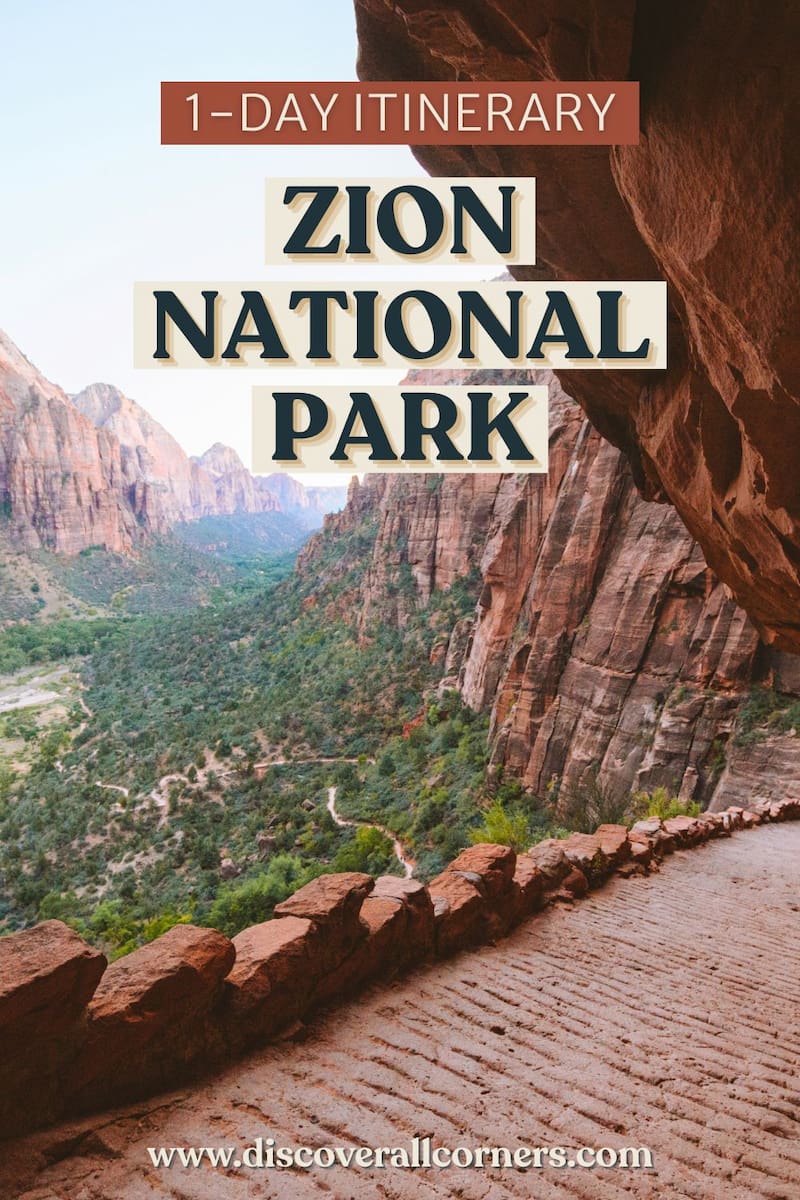
Quick navigation
Plan your visit:
- Zion entrances + Bighorn sheep sightings
- Start your day at Zion Canyon Visitor Center
- Quick overview of the 1-day Zion itinerary
- Get your bearings (Zion map)
The 1-day Zion itinerary:
- Morning: Emerald Pools + Kayenta Trail
- Midday: Weeping Rock
- Afternoon: Riverside Walk
- Optional stops if you have extra time:
Helpful tips for your Zion visit:
Zion entrances
Most visitors enter Zion National Park through the South Entrance near Springdale, which is the park’s main gateway and home to the Zion Canyon Visitor Center and the Zion Canyon shuttle system. This entrance provides the most direct access to the main scenic corridor of Zion Canyon, where many of the park’s most popular trails begin.
However, Zion also has an East Entrance, reached by driving the spectacular Zion–Mount Carmel Highway. This route winds through slickrock country before passing through the historic Zion–Mount Carmel Tunnel, a dramatic mile-long tunnel carved directly into the sandstone cliffs in the 1930s.
Both entrances have ranger stations, so park passes can be purchased or checked at either location.
Wildlife tip:
The stretch of road near the east entrance is one of the best places in the park to spot desert bighorn sheep. These agile animals are often seen on the rocky slopes along the highway and occasionally along the road itself, especially in the early morning or late afternoon.


Start your day early at Zion Canyon Visitor Center
Most visits to Zion National Park begin at the Zion Canyon Visitor Center, located near the south entrance of the park. It typically opens at 8:00 AM.
Parking fills quickly here (often by mid-morning during busy months), so arriving early in the morning makes for a much smoother start of the day.
From roughly March through November, private vehicles are not allowed on Zion Canyon Scenic Drive, which is the road that runs through Zion Canyon where most of the hikes and viewpoints are located. Instead, visitors use the free Zion Canyon Shuttle to access trailheads and viewpoints throughout the canyon, and its Springdale sister shuttle if the park’s lots are full.
The shuttle that services Zion Canyon stops at the Visitor Center and several major hiking areas. If you’re visiting for the first time, it’s helpful to review how the shuttle works before arriving.
Quick overview of this 1-day Zion itinerary
Morning
• Emerald Pools + Kayenta Trail
Midday
• Weeping Rock
Afternoon
• Riverside Walk
Late afternoon options
• Scout Lookout (strenuous hike)
• Pa’rus Trail (easy walk)
• Zion Human History Museum
Evening
• Canyon Junction sunset
Morning: Emerald Pools and Kayenta Trail
The Emerald Pools are a series of natural pools tucked beneath towering sandstone cliffs. It’s one of the best places to start your day in Zion, and an activity worth planning ahead since the pools can be reached via several interconnected trails starting at two different trailheads (Shuttle Stop #5 — Zion Lodge, and Shuttle Stop #6 — The Grotto).
Depending on the route you choose, the hike can be a short easy walk to the first pool in the series, or a quick moderate climb to all three pools for more dramatic scenery.
I recommend starting the hike at Zion Lodge (Shuttle Stop #5), which is also the quickest and easiest route to the first pool. If you’d like a detailed breakdown of the trail system and route options, see my complete guide to the Emerald Pools trails system in Zion.
Lower Emerald Pool
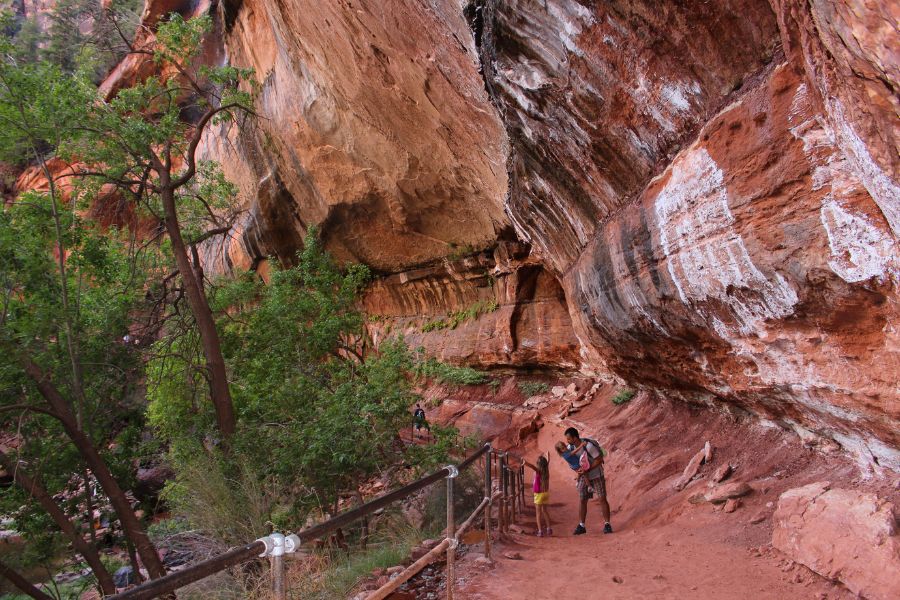
The first stop along this route is the Lower Emerald Pool.
A paved path climbs gradually for 0.6 miles toward a massive sandstone alcove dotted with plants growing straight out of its vertical walls, and waterfalls spilling over the edge in wetter seasons. The natural pool sits just below the trail, but the real draw is the alcove itself.
Many visitors turn around here, but continuing higher makes the hike far more rewarding.
Continue to the Middle and Upper Pools
Beyond the lower pool, the trail becomes steeper and more rugged as it climbs the final half mile toward the Middle and Upper Emerald Pools. These sections are rated moderate, with sandy, rocky, and uneven surfaces. The higher you go, the more rugged the trail becomes.
The Middle Pools sit along a sandstone ledge surrounded by trees and small streams, and from there, the trail climbs to the Upper Pool, tucked beneath a towering cliff wall. Unlike the first pool which sits below the trail, the subsequent pool areas are accessible and a great opportunity to take a break.
Return via the Kayenta Trail
There are several ways to return to the shuttle, but taking the Kayenta Trail toward The Grotto (Shuttle Stop #6) is one of the most scenic options, and the distance to this stop is roughly the same as returning back to Stop #5. This trail follows the canyon wall and offers sweeping views across Zion Canyon, creating a beautiful loop that adds variety to the Emerald Pools hike.
Midday: Weeping Rock

Next, ride the shuttle one or two stops up the canyon (depending on your return route from the Emerald Pools) to Shuttle Stop #7 — Weeping Rock, and the Weeping Rock Trail. This will be a quick but memorable stop.
A very short but steep paved path climbs from the sandy desert floor to a small alcove where water slowly seeps through sandstone layers above. The dripping water feeds a vibrant microhabitat including hanging gardens of moss, ferns, and wildflowers that cling to the canyon wall, creating a cool, green, refreshing oasis in an otherwise overwhelmingly desert-like environment.
What’s more, the water dripping down on the trail from the sandstone above can take thousands of years to reach the surface, making this one of the most unusual natural features in the park.
On hot summer days, the shade and mist here feel especially refreshing. It’s probably one of the best places to be when Zion Canyon is at its hottest.
Afternoon: Riverside Walk
No perfect one-day visit to Zion National Park would be complete without the Riverside Walk (2 miles out and back).
This easy paved trail begins at the final shuttle stop — Temple of Sinawava (#9) and ends where the famous Narrows hike begins, where hikers continue directly through the river.
The path follows the Virgin River deeper into the narrowing canyon with towering sandstone cliffs rising straight up on both sides. This is another lush corner of Zion where abundant vegetation lines the trail and hanging gardens cling to the canyon walls.

This trail is the single easiest way to experience Zion Canyon’s true nature. The downside? It gets crowded. And no, you shouldn’t skip it. This is one of the places in Zion that will linger in your memories.
PS: If you keep your eyes peeled, you may even spot the tiny endemic Zion snail here.
Optional stops if you have extra time and energy
Depending on your energy level and how much daylight remains, there are several ways to end your amazing day in Zion Canyon.
For ambitious hikers: Scout Lookout on the West Rim Trail

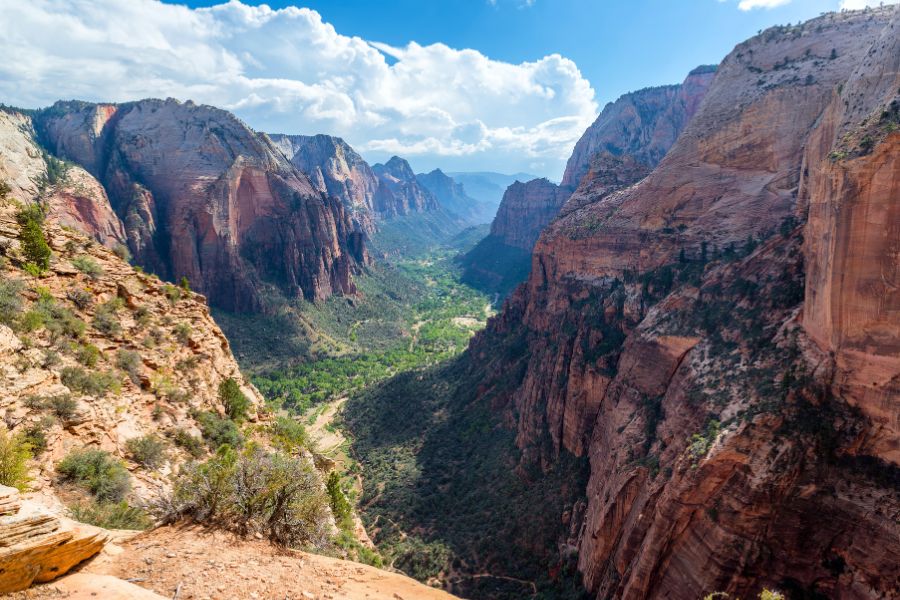
If you’re up for a more demanding climb after exploring the main canyon trails, consider hiking part of the West Rim Trail to Scout Lookout and toward the hyper-famous, intense Angels Landing Trail. Many hikers actually consider Scout Lookout one of the best viewpoints in Zion Canyon — even without continuing to Angels Landing (which now requires a permit).
The trail begins at The Grotto (Shuttle Stop #6) and climbs steeply through a side canyon before reaching the famous switchbacks known as Walter’s Wiggles. From the top, Scout Lookout offers sweeping views across Zion Canyon. We haven’t done this hike ourselves yet because our kids were still small when we visited the park, but it’s on my bucket list!
While Scout Lookout itself does not require a permit, the climb is steep and includes exposed sections typical of many Zion hikes. For visitors comfortable with heights and a solid uphill hike, it can be one of the most rewarding viewpoints in the park.
Distance to Scout Lookout is about 4 miles round trip and involves an elevation gain of approx. 1,000 feet. This hike is rated as strenuous. See the map below for the route.
For an easy scenic walk: Pa’rus Trail
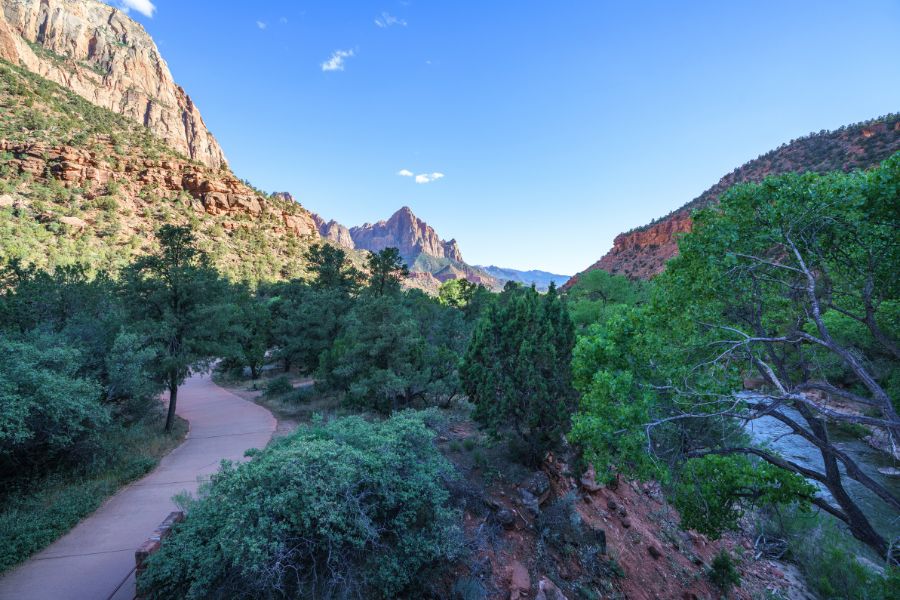
If you’d rather end the day with something relaxed, the Pa’rus Trail is a pleasant paved walk along the Virgin River with multiple access points near the park’s South Entrance.
This is one of the few trails in Zion open to bicycles and leashed pets, and it’s a beautiful place for a late afternoon stroll beneath the canyon cliffs.
You can connect with this trail from the Visitor Center or shuttle stops 2 (Zion Human History Museum) and 3 (Canyon Junction), but only on the way back toward the Visitor Center since the shuttle doesn’t stop here on the way up. The distance between the Visitor Center and Canyon Junction is about 1.7 miles, and with multiple access points, you can easily tailor this hike to your schedule.
For a quick cultural stop: Zion Human History Museum
Located at Shuttle Stop #2, the Zion Human History Museum offers exhibits about the geology, wildlife, and human history of the canyon. This stop is only accessible on shuttles returning to the Visitor Center. The museum can also be reached via the easy, paved Pa’rus Trail (the distance between the museum and the Visitor Center is about 1 mile).
Current hours are posted on the park website.
Sunset: Canyon Junction
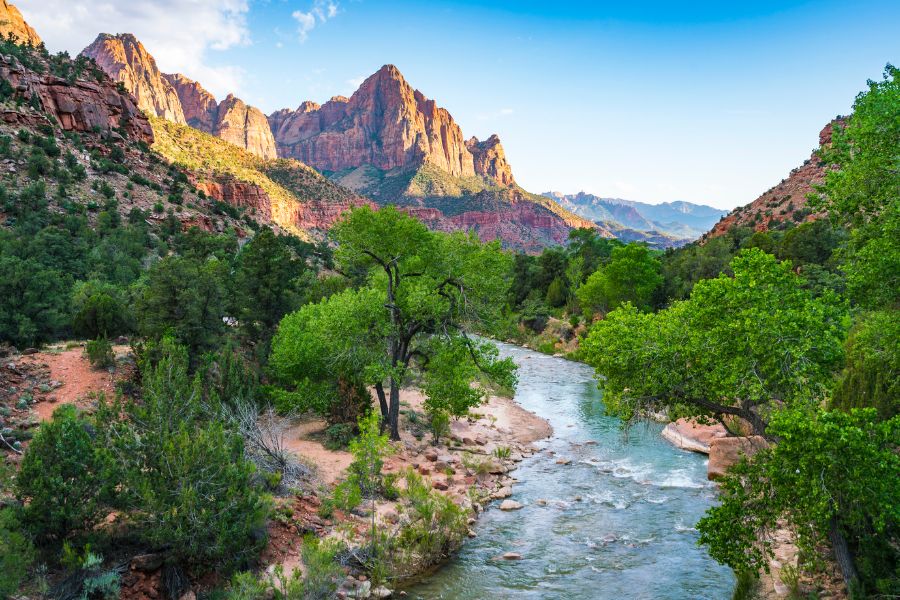
If you’re still in the park toward evening, one of the most famous sunset views in Zion is found near Canyon Junction Bridge (Shuttle Stop #3), where the Virgin River curves beneath the Watchman peak and the paved Pa’rus Trail ends.
This is a down-canyon stop only, meaning you can only board or exit the shuttle at this stop when the bus is traveling down-canyon toward the Visitor Center. You can also drive here — there is a small parking lot just west of the bridge. (Private vehicles are only restricted on Zion Canyon Scenic Drive which begins at this junction.)
This is a classic Zion photo spot for any time of the day, but especially in the evening when the surrounding rock faces and Watchman Peak begin to glow orange. The only catch is, if you want to stay for the sunset, and all the last shuttles returning to the Visitor Center are full, you’d have to walk back (unless you plan ahead and drive here instead).

Zion National Park map (interactive)
This helps you see where everything actually is, so that you can plan your day without second-guessing it.
Save this before you go (cell service is spotty to non-existent past the Canyon Junction area).
Food options inside and near the park
When visiting Zion National Park on a tight schedule, it’s a good idea to have a rough plan for meals so you don’t lose valuable time searching for food.
Zion Lodge dining
Located in the middle of Zion Canyon at Shuttle Stop 5 — Zion Lodge, Red Rock Grill is the most convenient place to grab lunch inside the park. There is also a cafe here. The lodge sits beneath towering canyon walls and offers indoor seating along with shaded outdoor tables. Even if you only stop here briefly, it’s a pleasant place to take a break before continuing your day in the canyon.
Restaurants in Springdale
Just outside the park’s south entrance, the town of Springdale has numerous restaurants, cafes, and casual spots for breakfast or dinner. If you’re staying nearby, this is usually the easiest place to eat before or after your park visit.
Cordwood at Zion Mountain Ranch
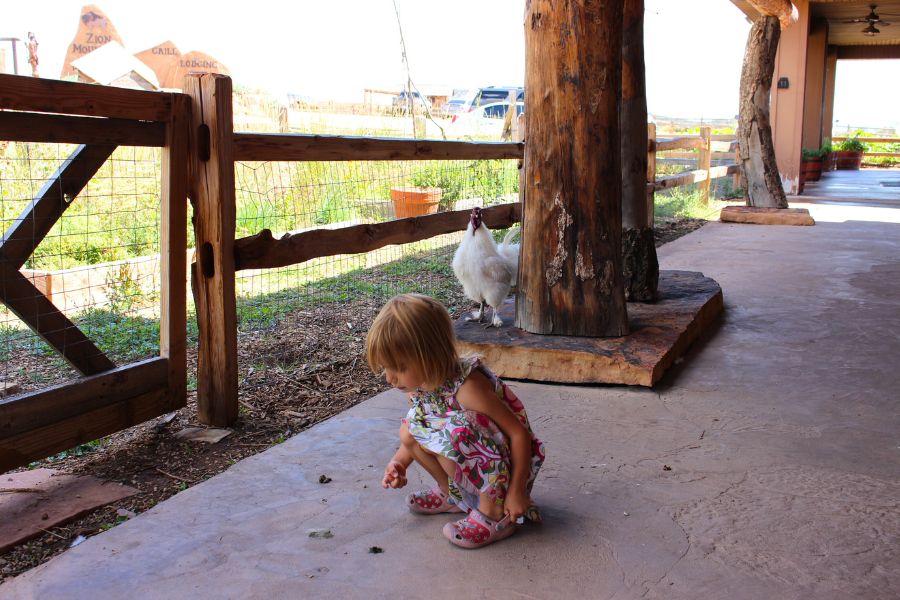
If you happen to enter or exit the park through the East Entrance, a memorable stop for a meal is Cordwood at Zion Mountain Ranch, about 4 miles east past the park entrance booth. This rustic restaurant might have a small menu, but they are known for farm-to-table style dining based on locally sourced ingredients, and the ranch property itself adds to the experience. We had an excellent meal here, and goats, chickens, and other animals are often seen around the grounds, making it a particularly fun stop for families.
Tips for making the most of one day in Zion
A few simple strategies can make a huge difference when visiting Zion National Park on a tight schedule.
- Arrive early. Parking at the Visitor Center often fills by mid-morning during busy months.
- Bring water and snacks. Even short hikes in Zion can feel strenuous in the desert heat. Several water bottle refill stations are located throughout the park.
- Link nearby trails together. For example, combining Emerald Pools with the Kayenta Trail avoids extra shuttle rides.
- Expect crowds on popular trails like Riverside Walk and the lower section of the Emerald Pools area. Starting early helps avoid the busiest times.
- Check trail conditions at the Visitor Center or on the park website before your visit, as closures sometimes occur due to rockfalls or weather.
Even with just one day, a visit to Zion National Park can leave a lasting impression. You may arrive planning a quick visit, but chances are you’ll leave already thinking about coming back.


Hi, I’m Marketa!
Mom of two, Malinois wrangler, and the voice behind this blog. I share places worth the detour across the U.S., from remote backroads to favorite Chicago-area finds. Always chasing good views, great memories, and dog-friendly stops. More about us →


