
Zion National Park is famous for its towering cliffs and legendary hikes. But beyond the postcard views, this canyon holds stories most visitors never notice. From quietly shifting cliffs to rare animals hidden in plain sight, these are the unexpected details that make Zion truly unforgettable.
Zion National Park was one of those parks that left us in awe. We thought we knew what Zion would be like. The iconic trails. The glowing red cliffs. The big views. The crowds. But the moment we arrived, our trip went off script.
We visited years ago, when the kids were still little enough to think every canyon wall was the tallest thing on Earth. Cruising through the Southwest without rigid plans, we happened to arrive on a fee-free day… which felt like winning the lottery until we realized everyone else had the same idea.
The park was packed. Campgrounds were full. We ended up staying just outside the park that first night, hoping for a miracle.
The next morning, my husband woke up before sunrise to try for one of the few campsites that would open up that day. He got one. And suddenly we were waking up inside Zion, realizing it was more than just scenic. The canyon felt alive, layered, and full of details we hadn’t noticed at first.
Zion is beautiful in the obvious ways.
But it’s the unexpected details that make it unforgettable.
1. The water dripping on you is ancient
At places like Weeping Rock and along sections of the Riverside Walk, you’ll notice lush patches of plants growing straight out of the canyon walls. These are Zion’s hanging gardens, sustained by water that slowly seeps from the cliffs.
That water is not your ordinary water.

While recent rain or snowmelt can create a temporary faster flow, the consistent “weeping” you see year-round comes from something much older.
Some of this water began as snow or rain on Zion’s high Navajo Sandstone plateaus, slowly working its way through the rock layers — for centuries or even millennia.
It’s a perfect example of a natural, slow-release filter.
The water travels downward through the porous sandstone until it reaches the Kayenta Formation below, a denser layer that stops it from continuing deeper. With nowhere else to go, it’s forced sideways through the canyon walls, where it finally emerges as the constant seep that sustains Zion’s hanging gardens.
Carbon dating shows that some of this water has been underground for 1,000 to over 4,000 years before finally reaching the open air.
So when you walk beneath those dripping cliffs, you’re not just feeling canyon mist. You’re standing under ancient water that began its journey thousands of years ago.

2. The canyon is still being carved right now
Zion Canyon isn’t a finished masterpiece from the distant past. It’s still being shaped today.
The Virgin River continues to deepen and widen the canyon, especially during flash floods that move huge volumes of water, sediment, and rock. Sudden storms can increase the river’s flow more than 100 times, undercutting softer layers like the Kayenta Formation and triggering rockfalls and collapses.
This ongoing force is most visible upstream of the Temple of Sinawava, where the North Fork of the Virgin River is still actively cutting through Navajo Sandstone, shaping the slot canyons of The Narrows.
When you walk The Narrows, you’re not just hiking through scenery. You’re moving through a landscape that’s still being sculpted today.
That makes Zion feel less like a static landscape and more like a system still in motion.

Related: 9 Easy and Moderate Hikes in Zion National Park (Easy Doesn’t Mean Boring)
3. Four distinct ecosystems within one park
Thanks to an elevation range spanning roughly 3,700 to over 8,700 feet, Zion National Park contains four distinct life zones:
- Desert (low elevation)
- Riparian (river corridor)
- Pinyon–juniper woodland (mid elevation)
- Coniferous forest (high elevation)
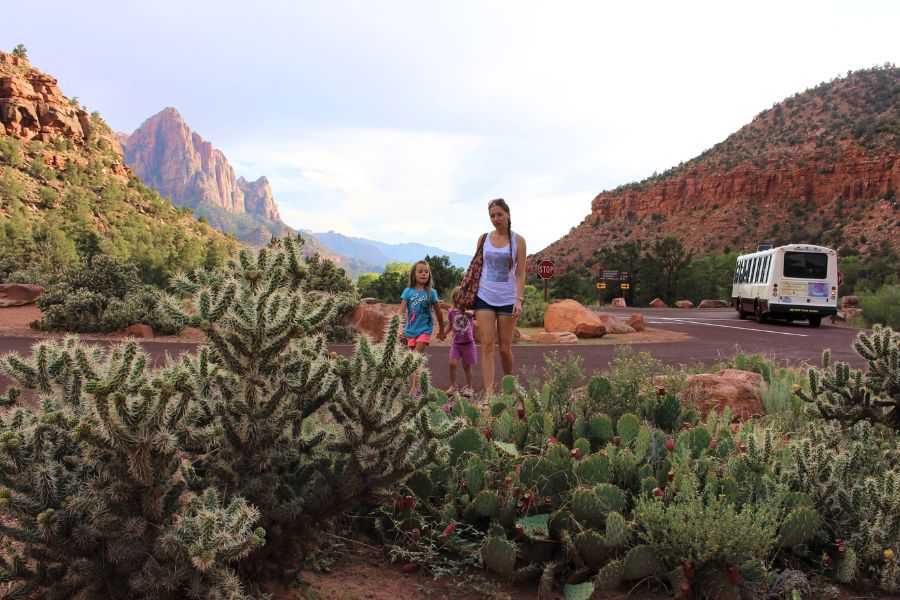


This diversity supports over 1,000 plant species, 78 mammals, and nearly 300 bird species.
Which explains why one moment you’re surrounded by cactus and slickrock, and a short drive later you’re in a pine forest that feels like an entirely different region.
4. California condors still fly here
Zion National Park is one of the places where you might spot a California condor.
They’re the largest land birds in North America, with wingspans approaching 10 feet.
Not long ago, they were nearly extinct in the wild.
Seeing one in Zion isn’t just cool. It’s conservation in motion.

They’re often spotted along the Angels Landing corridor, especially near Scout Lookout or the chained sections, but even Shuttle Stop 8 is a surprisingly good place to spot them soaring overhead.
Your best chances are between May and November (peaking in the summer months), especially in the morning when canyon thermal updrafts help them glide.
5. Tarantulas roam the park (seasonally)
Late summer and early fall is tarantula mating season in southern Utah. That’s when males wander out in the open, searching for females.
Yes, they’re the largest spiders in the American Southwest.
No, they’re not chasing hikers.
They’re just… determined.
It’s one of those reminders that Zion isn’t manicured wilderness. It’s the real desert.

And where there are tarantulas, there are also tarantula hawks.

These wasps paralyze tarantulas with a powerful sting, drag them underground, and use them as hosts for their young. Brutal, but it’s nature doing what it does. We actually saw this unfold along a trail in the park, and it was hard to watch.
And if you’re wondering which one to fear more?
It’s not the spider.
The tarantula hawk delivers one of the most painful insect stings on Earth, second only to the bullet ant.
PS: One of its lesser-known hobbies includes drinking fermented nectar and going on what can only be described as drunken flying sprees — if it can even get off the ground. Reckless. Fearless. Completely unapologetic. Nature’s own winged gangster.
6. The Zion snail exists nowhere else
Tucked into Zion’s hanging gardens lives a tiny species known as the Zion snail, about the size of a pinhead. Despite its size, it has proportionally the largest foot of any snail, allowing it to cling to slick rock faces even during periods of high water flow.
It exists nowhere else on Earth.
Even within the park, it’s only found in a handful of seeps and hanging gardens in Zion Canyon and Orderville Canyon. Trails like the Riverside Walk and parts of The Narrows pass through this habitat, but most visitors will never notice the snail due to its size.
Still, knowing something this small depends entirely on those dripping canyon walls makes the hanging gardens feel even more alive.
If you do happen to spot one, don’t touch it. Their shells are extremely fragile.
7. It wasn’t always called Zion National Park

The park was originally established as Mukuntuweap National Monument in 1909. The name came from a Southern Paiute word thought to mean “straight canyon” or “straight river.”
But it proved difficult for visitors to pronounce, and in 1918 the name was changed to Zion, a term used by Mormon settlers, meaning “a place of peace.”
In 1919, it became Utah’s first national park.
Standing in the canyon, you understand why they chose a word that meant sanctuary.
Related: One Perfect Day in Zion National Park (How to See It All)
8. Zion National Park is bigger than most people realize
Most visitors experience Zion National Park through its main canyon — Zion Canyon — the dramatic, shuttle-accessed core of the park.
But that’s only part of the park.
About 40 minutes away lies Kolob Canyons, a separate canyon system with the same towering red rock walls and lush valleys but far fewer crowds. It’s also home to Kolob Arch, one of the longest natural arches in the world.

Zion Canyon 
Kolob Canyons
Add in the Zion–Mount Carmel Highway slicing through the east side, complete with a historic tunnel and an entirely different vibe.

Zion-Mount Carmel Highway 
Zion–Mount Carmel Tunnel
Zion isn’t just one canyon.
It’s a vast area that stretches well beyond the shuttle route.
9. Crowds are part of the experience
Zion is one of the most visited national parks in the country.
Yes, it gets crowded.
Yes, campsites are hard to get.
Yes, shuttle lines are part of the experience.
And it’s still worth it.
Because when you’re standing beneath towering sandstone walls shaped over millions of years, when the refreshing mist of ancient water reaches you, when a condor glides overhead or you realize a tiny snail exists only here…
You understand why people keep coming back.
We went expecting beautiful views and left with something much deeper.
The scale of Zion somehow absorbs the crowds and still makes you feel small in the best way.
Zion lives up to the hype.
Crowds and all.


Hi, I’m Marketa!
Mom of two, Malinois wrangler, and the voice behind this blog. I share places worth the detour across the U.S., from remote backroads to favorite Chicago-area finds. Always chasing good views, great memories, and dog-friendly stops. More about us →


