When we first drove into Capitol Reef National Park, we thought we had a pretty good idea of what to expect.
Red rocks. Scenic drives. Maybe a hike or two?
Then suddenly we were standing in a lush historic orchard in the middle of the desert, hiking through a canyon named after outlawed marriages, and looking at old telephone poles in a remote rugged canyon corridor among other curiosities.
Capitol Reef turned out to be one surprise after another, and yet all the puzzle pieces seamlessly connected together.
If you’re already planning a visit, these are the stories, quirky details, and pieces of history that made us appreciate the park so much more once we were standing there ourselves. Because once you understand the backstory, Capitol Reef stops being “another Utah national park” and starts becoming one of the most interesting places in the state.
👉 If you’re curious where all those puzzle pieces lead, here’s a quick overview:
The single geological feature that created Capitol Reef
If there’s one thing to know about Capitol Reef National Park, it’s this: the park only exists because of the Waterpocket Fold. This nearly 100-mile-long wrinkle in the Earth’s crust is responsible for almost everything you’ll see here, from the towering cliffs and domes to the narrow canyons and unexpected pockets of greenery.
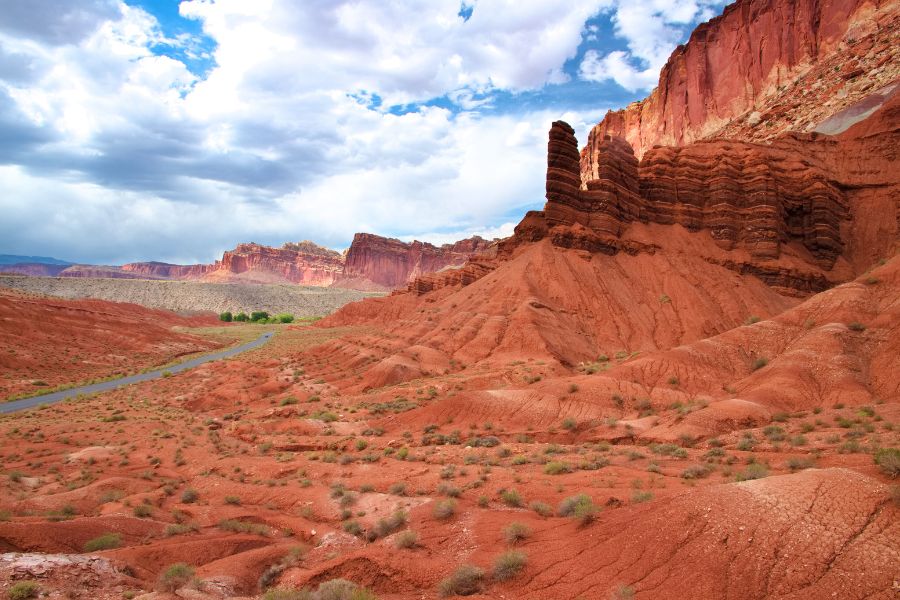
Millions of years ago, powerful forces deep underground slowly bent layers of rock upward instead of breaking them apart. Then wind, rain, and time took over, carving today’s landscape into the rugged scenery that makes Capitol Reef so distinctive. Rainwater collected in natural depressions along the folded rock, creating “waterpockets” that gave the formation its name and provided a precious source of water in an otherwise unforgiving desert.
The funny thing is that you don’t really need to understand the geology before visiting.
We certainly didn’t.
But once we learned the connection of this single rock formation to nearly every stop we made during our visit, the entire park suddenly started making a lot more sense.
In many national parks, geology simply creates a beautiful backdrop.
At Capitol Reef, geology is the entire story.
A desert farming town that shouldn’t have worked
If you’re visiting Capitol Reef for the first time, this is the area that will probably surprise you the most.
As you drive into the park, you’re greeted by miles of rugged desert scenery. And just when you’re getting used to that landscape, the road suddenly drops you into a pocket of greenery so lush it looks completely out of place.
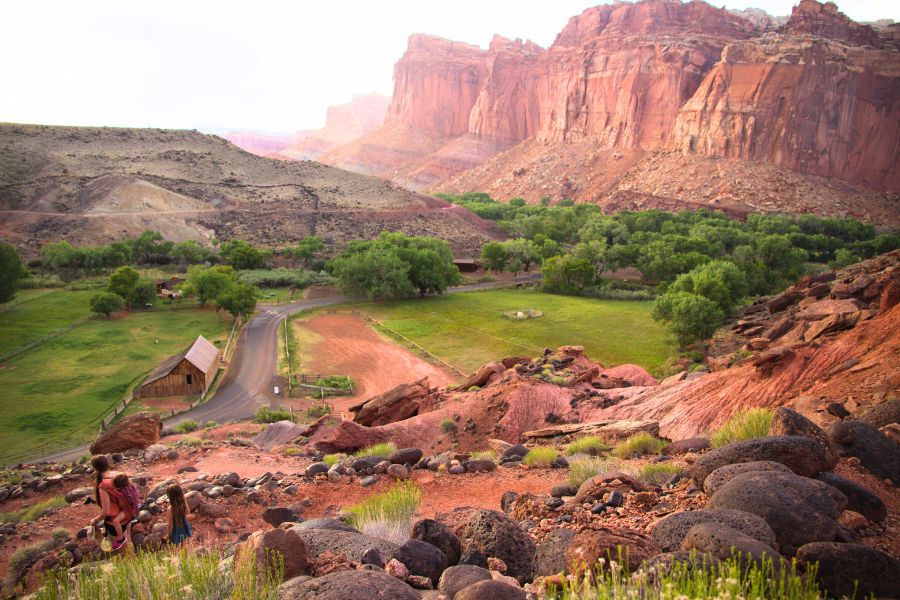
This little oasis is Fruita, a tiny historic farming community established by Mormon settlers in the late 1800s. It’s filled with green lawns, towering cottonwood trees, and several fruit orchards.
Considering the surrounding landscape, none of this should really exist. But thanks in part to the Waterpocket Fold, which helped shape the flow of the Fremont River through this valley, a clever irrigation system, and an impressive amount of perseverance, early settlers somehow managed to transform this desert valley into productive farmland.
Life here certainly wasn’t easy. Fruita was isolated, and floods, snowstorms, and rough roads regularly cut residents off from the outside world.
Yet somehow, it worked.
Today, Fruita Historic District remains one of the most unique parts of Capitol Reef National Park. The orchards are still here, producing fruit more than a century later, and several original buildings remain as well.
For most visitors, Fruita is simply a beautiful place to stop and escape the desert heat for a while. But it’s so much more than that. Everything you see here exists because a small group of people somehow figured out how to make life work in one of the most unexpected places imaginable.
Even if you’re only visiting for a day, don’t skip this section of the park. Our one-day Capitol Reef itinerary shows exactly how to fit Fruita into your visit.
You can pick fruit inside Capitol Reef
Out of all the things you typically expect to be able to do in a Utah national park, fruit picking is probably not on that list.
And yet here we are.
One of the coolest things about Capitol Reef National Park is that the historic Fruita orchards are still active today, continuing a tradition that began more than 100 years ago. And the second coolest thing is that visitors are welcome inside these orchards.
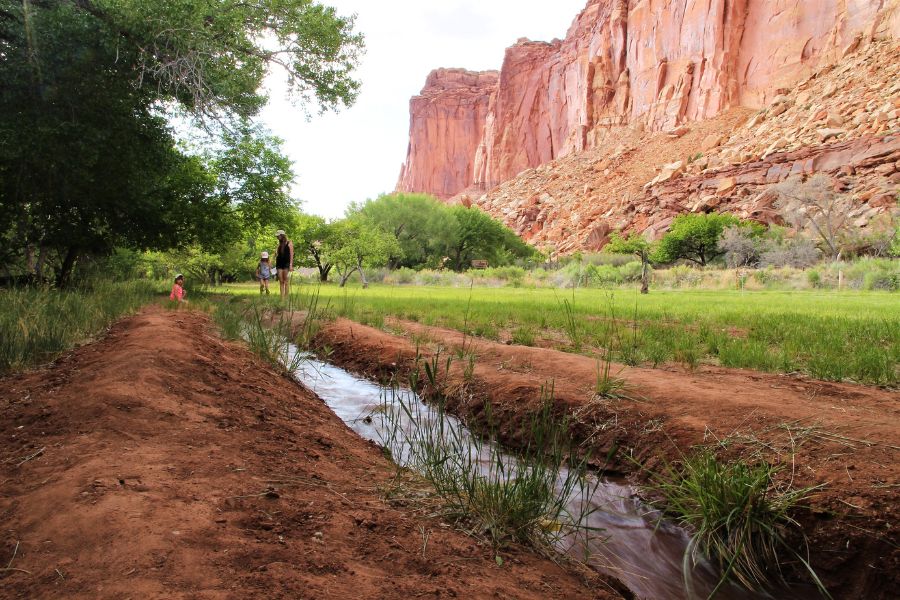
During harvest season you can even walk through the orchards and sample ripe fruit straight from the trees for free, or purchase some to take home for a small fee. How amazing is that?
There are roughly 2,000 fruit trees growing throughout Fruita, including apples, apricots, peaches, pears, cherries, plums, and a handful of nut trees. Many of them are heirloom varieties you rarely see anymore.
The fresh fruit itself is obviously a huge perk. But honestly, that’s not even the best part.
There is something wonderfully bizarre about eating a freshly picked peach while standing among red rock cliffs in the middle of the Utah desert. Suddenly all those orchards stop feeling like a tourist attraction and start feeling like what they actually are: living pieces of Capitol Reef’s history.
Even outside of harvest season, the orchards are still worth visiting. Spring brings beautiful blossoms, while late summer and fall are when many of the fruits begin ripening.
We visited in late spring while the orchards were blooming, so we missed out on the free fruit this time. Which, honestly, sounds like a pretty good excuse to come back.
Why everyone talks about pie at Capitol Reef
Before visiting Capitol Reef, we thought people were wildly exaggerating this whole pie situation.
They weren’t.
Pie is practically a personality trait here.
If the orchards are the heart of Fruita, the historic Gifford House is its social hub. Originally built in 1908 as a family home, it now operates as a small museum and gift shop, but let’s be honest… most people are here for the pie.
Made with fruit from the surrounding orchards, these pies are more than dessert. They’re a delicious piece of the valley’s history.

Apple, cherry, peach, apricot, pear, and plum flavors all make appearances throughout the bakery season, and yes they’re worth the hype. We’ve tried multiple flavors and every single one was delicious. There’s also homemade ice cream, coffee, cinnamon rolls, and even freshly baked bread available.
The Gifford House is typically open from mid-March through late November, so don’t plan your entire visit around pie if you’re coming during the winter months.
We also quickly learned this isn’t an “after dinner dessert” situation. Get there early because the popular flavors disappear fast.
Also, if you’re camping at the Fruita Campground, you’re dangerously close to making pie part of your breakfast routine…
Fresh pie for breakfast in the middle of a Utah desert oasis?
Honestly, that’s peak Capitol Reef.
Why Cohab Canyon has such an unusual name
We originally hiked Cohab Canyon simply for the views, but learning the story behind its unusual name made the experience even more memorable.
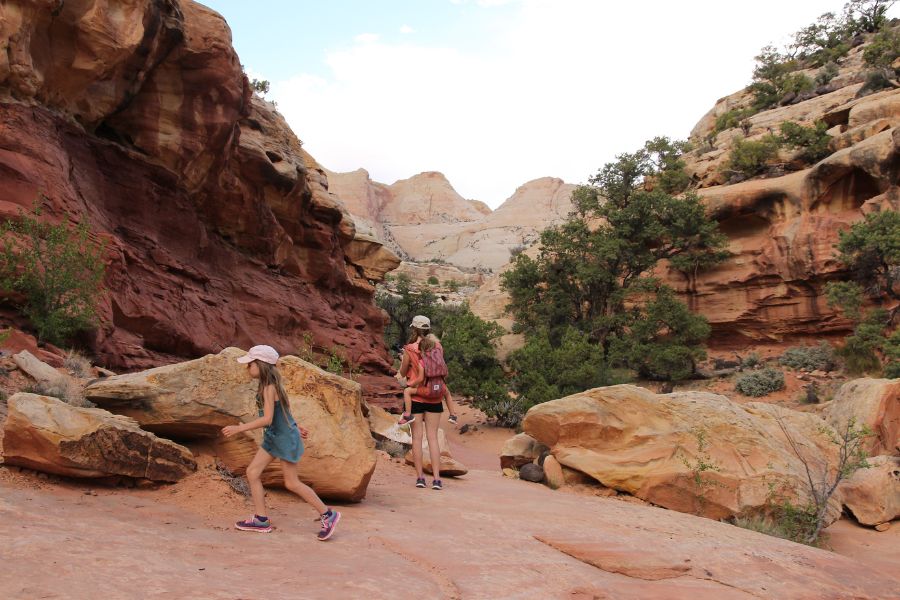
As it turns out, “Cohab” isn’t a random word at all.
It comes from the term unlawful cohabitation, which was used during the federal crackdown on Mormon polygamy in the late 1800s. Instead of prosecuting bigamy, authorities often charged men with unlawful cohabitation because it was much easier to prove. People accused of practicing plural marriage eventually became known as “cohabs.”
Local history suggests this canyon may have served as a discreet travel corridor or temporary hiding place during that period. Its side canyons, alcoves, and hidden corners certainly make it easy to see why.
Whether every story is entirely true almost doesn’t matter. Once you know the backstory, the canyon suddenly feels different. You’re no longer just hiking through a pretty canyon. You’re walking through a place that quietly carries a piece of Utah’s complicated history.
Today, Cohab Canyon is one of our favorite hikes in Capitol Reef. The trail climbs quickly above Fruita and rewards you with sweeping views, colorful rock walls, and several fun side slot canyons to explore along the way.
And honestly, knowing the origin of the name made the hike ten times more interesting for us.
If you’re already planning to grab a pie from the Gifford House, this hike pairs perfectly with that stop since one of the trailheads is located right in Fruita.
You can still see pioneer signatures inside Capitol Reef
This historic registry carved into the canyon walls might just become one of your favorite easy stops in the park.
Today, this area is known as Capitol Gorge, but before modern roads existed, this narrow canyon was the main route through the Waterpocket Fold.
In the late 1800s and early 1900s, settlers, prospectors, and travelers passing through often carved their names and dates into the canyon walls as they went by. And somehow, many of them are still here.

Today, you can see these inscriptions for yourself on the easy Capitol Gorge Trail at the end of the Capitol Reef Scenic Drive (which is well worth doing on its own!).
One thing that surprised us was how high some of the signatures sit above the ground. That’s because the canyon floor used to be much higher than it is today. Over time, erosion gradually lowered it, leaving many of the carvings seemingly out of reach.
But honestly, what makes this stop so fascinating isn’t just the names and initials themselves. It’s realizing that you’re standing on the exact same route people once used to navigate this rugged desert landscape more than a century ago.
As you continue farther into the canyon, keep an eye out for metal rods protruding from the rock walls. They’re remnants of an old telephone line that once ran through the gorge, adding yet another unexpected layer of history to this already fascinating place.
Who was Doc Inglesby, anyway?
The first time I saw the name Doc Inglesby Picnic Area in the park brochure, I immediately had questions.
Who was Doc Inglesby?
As it turns out, he was a real person.
Dr. A. L. Inglesby was actually a retired dentist and passionate rockhound from Salt Lake City who fell in love with Fruita and moved here in 1936. He eventually purchased several acres of land, built a home, and even added a couple of guest cabins that he rented to visitors. Over time, his little desert retreat attracted artists, geologists, authors, and fellow rockhounds who wanted to experience this remote corner of Utah for themselves.
When the National Park Service later acquired the land, the buildings were removed, but his name remained.
Today, the Doc Inglesby Picnic Area sits where his property once stood.
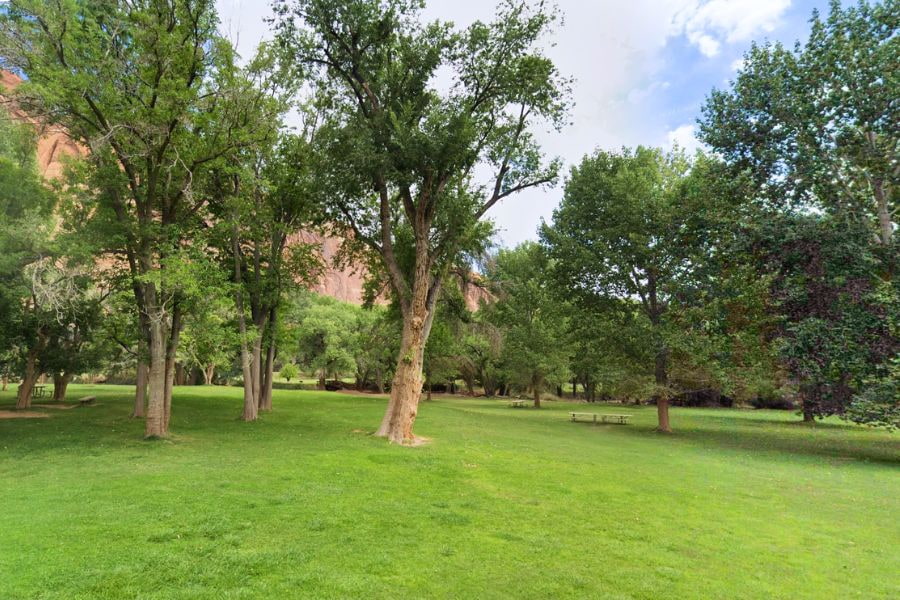
And honestly, we love little details like this because they transform a random name on a park map into a real person with a story.
If you’re grabbing a pie from the Gifford House, this is also a fantastic place to sit down and enjoy it.
How Capitol Reef became a national park

Long before Capitol Reef became a national park, it was protected as a national monument. In fact, that designation dates back to 1937, when President Franklin D. Roosevelt recognized just how special this landscape was and officially protected it.
One of the people advocating for the area was Dr. A. L. Inglesby — yes, the same Doc Inglesby from the picnic area above.
At the time, Fruita was incredibly small. A 1930s guidebook described it as an “eleven-house village of many orchards, set in a pocket surrounded by towering cliffs,” which honestly paints a pretty accurate picture even today.
For decades, Capitol Reef remained a relatively quiet national monument before Congress elevated it to national park status in 1971.
This is a good reminder that this place wasn’t always the well-known destination it is today. Many of the orchards, historic buildings, and experiences people now associate with Capitol Reef could have easily been lost over time. Instead, they’re still here for all of us to enjoy.
And maybe when you pass the Doc Inglesby Picnic Area on your visit, you’ll see more than just green shaded lawn…

Hi, I’m Marketa!
Mom of two, Malinois wrangler, and the voice behind this blog. I share places worth the detour across the U.S., from remote backroads to favorite Chicago-area finds. Always chasing good views, great memories, and dog-friendly stops. More about us →